

What is important for parents of schoolchildren to know about dental services for children?
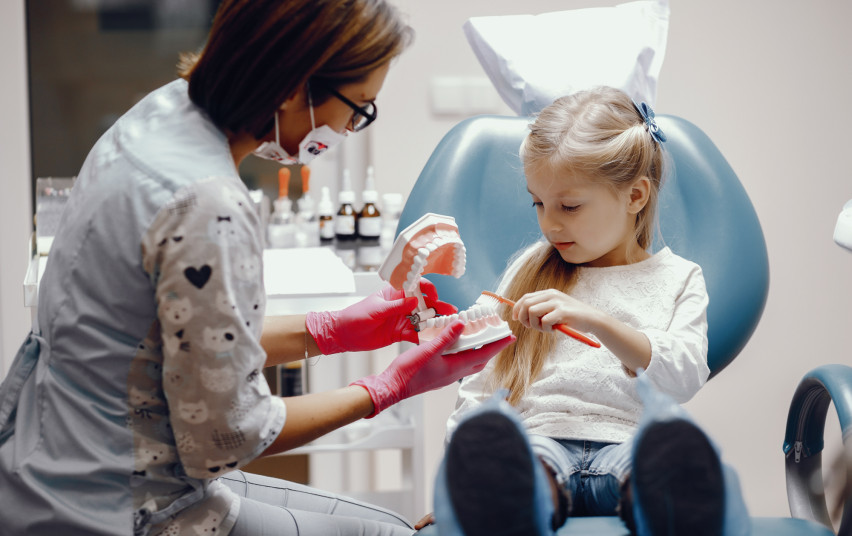
Summer is a good time to relax and take care of your children’s health, so that they don't get disturbed by ailments, including dental problems, when school starts. The health insurance funds explain which preventive, dental and prosthetic services and orthodontic appliances for children are covered by the Compulsory Health Insurance Fund, and where and how to go to get them.
Primary dentistry - in your outpatient clinic
Both for the health certificate that must be submitted to the school and for the health of your children before the school year, it is important to make sure that your child’s teeth and jaws are checked by a dentist, that preventive measures against tooth decay are taken, and that dental treatment is provided if necessary. This primary dental care must be provided by family medicine providers such as polyclinics, family medicine clinics, centres, etc. to their enrolled patients. If a family medical institution does not provide primary dental care, another medical institution has to provide it to the people enrolled in the clinic under contract with the institution.
“Children and full-time students of general education or vocational schools up to the age of 24 must be provided with essential, preventive and curative dental care at public expense in the medical institutions where they are registered. Specifically, these establishments do not have to pay for annual preventive check-ups for these patients, treatment of dental caries, tooth decay, inflammation of the tooth nerve, gingivitis, other diseases of the teeth, jaw, gums, tongue, oral mucosa, extraction of the teeth and their roots, determination of the probability of pre-cancerous diseases, and the application of temporary splints for the treatment of dental injuries,” – says Vaida Bernotienė, Adviser to the Population Services Division of the Vilnius Territorial Health Insurance Fund.
The representative of the Health Insurance Fund also stresses that patients of the above-mentioned age do not have to pay not only for the primary dental services listed above, but also for the anaesthesia, fillings, and other dental materials that are used during the dental services, if they are not chosen to be more expensive than the ones that are paid for by the Compulsory Health Insurance Fund (CHIF).
Prevention is an important part of primary dentistry
To prevent the need for dental treatment, it is important to assess children's dental hygiene skills and choose preventive measures. Once a year, children should be given this free of charge at the family medical centre where they are registered.
Children aged 13-18 should also receive free oral hygiene once a year, which involves assessing the condition of the mouth, removing plaque, polishing and, for children under 13, removing tartar above and below the gums as many times as the doctor deems necessary.
It is useful to use dental sealants, which are provided by CHIF when the first permanent molar tooth erupts before the age of 14. The procedure involves coating the surface of the healthy permanent molars with an enamel to prevent bacteria and carbohydrates from entering the grooves and hollows of the teeth, thus protecting the teeth against decay in the long term. The sealant-coated teeth are checked after 3 months, and then at each preventive check-up. Once the sealant has fallen out, the coating procedure is repeated.
Orthodontic appliances can be reimbursed
It is also important to check the bite of children’s teeth. The dentist at the treatment centre where the child is registered can refer the young patient to an orthodontist if necessary. If the orthodontist decides that the child needs an orthodontic appliance due to oral cavity, jaw diseases, congenital malformations of the craniofacial bones, it can also be reimbursed by CHIF.
According to the data of the National Health Insurance Fund (NHIF), this year almost EUR 1.5 million has been allocated for reimbursement of orthodontic appliances. In the first half of this year, 4 700 pieces of orthodontic appliances have already been reimbursed to Lithuanian children. More than EUR 724 000 from the CHIF has been spent to pay for them.
Children's dentures are covered by health insurance funds
Children under 18 can also receive reimbursable dental care with a referral. According to V. Bernotienė, if the masticatory system is still developing, dentures are made of polymerizable temporary dentures or standard protective metal crowns. The reimbursement amount for these is up to EUR 342.13. If the masticatory system is established, permanent dentures made of structural materials are used, for which reimbursement may be up to EUR 2 062,70.
NHIF estimates that more than 2 200 children in the country received reimbursed dentures last year. The CHIF funds needed to pay for them amounted to EUR 2.1 million. Where and how to apply?
For reimbursable primary dental services, for the determination of the need for dentures and for dental sealants, you need to go to the health care institution where you are registered and no referral is required.
Orthodontic appliances are referred by a dentist orthodontist to medical institutions that have concluded a contract with the Health Insurance Fund for these services. For a list of treatment facilities that have concluded agreements with the health insurance funds, click here.
(Freepik photo)
The NHIF invites you:
- Read the most important news on Facebook: https://goo.gl/ML8SqJ
- See recent pictures on Instagram: https://goo.gl/tXvpXr
- Watch comprehensive and funny videos on Youtube: https://goo.gl/BPBep2
- Follow exclusive infographics and more in Flickr: https://goo.gl/Hsyhq4
- Follow us on LinkedIn: https://tinyurl.com/2sxfh66j
- Your questions are welcome by email [email protected] or phone +370 5 232 2222