

A real-life story: key to a successful trip is the European Health Insurance Card
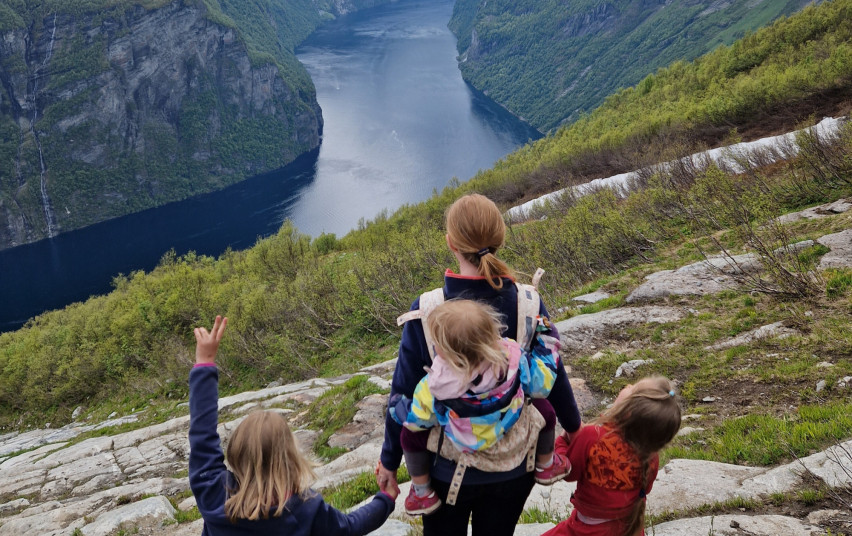
“90% of our family trips are active – that’s what we like the most,” says Lina Vasiliauskienė, mother of three daughters and founder of the travel project “Nėra blogo oro” (en. There is no bad weather). She notes that all her children are curious, inquisitive girls, so she always makes sure she has a European Health Insurance Card (EHIC) when she travels abroad. Experience has shown that this document is the key to a successful trip.
Travelling is a way of life
“Before we had children, my husband and I travelled extensively during our holidays. When I was expecting my first daughter, I knew that our hobbies and lifestyle would not change. When my daughter came into the world, motherhood scared me a bit, I didn't know how to react in certain situations. Let alone travelling,” the woman smiles, recalling that her first independent trip with a baby of a few months old was from Vilnius to Vištytis in a car to visit her grandparents.
“When I was preparing for the trip, I kept wondering how it would be to drive when the baby is in the car seat in the back and I can’t see her, what I should do if she starts crying, etc. But I decided that if I didn’t try, I wouldn’t find out. Since everything went well that time, I became more courageous and slowly expanded my geography of travelling”, says L. Vasiliauskienė.
Later, the family had two more girls. However, this did not stop the desire to travel, but perhaps changed the nature of the trips and the destinations a little. “We usually travel by car and tend to go where the climate is similar to Lithuania’s, the nature is not too different, the viruses and bacteria are the same,” the woman smiles.

Diseases can hit you unexpectedly
This June, as their daughters grew a bit older, the family finally decided to fulfil an old dream - to go on a campervan trip to Norway for a couple of weeks. “The motorhome trip was 100% worth it. I laughed at the beginning of the trip that I would never want to travel any other way again. Especially since when my eldest daughter got sick, it was very convenient to nurse her and take care of the other two, because everything was right there: a bed for the sick and a field with activities for the little ones. We didn’t feel trapped, as we would have been in a hotel room,” explains L. Vasiliauskienė, adding that she takes a simple approach to problems on trips.
It all comes down to the attitude: what is challenging and difficult for one person is simply an inconvenience for another. Of course, to avoid unplanned travel events becoming major problems, it is important to prepare properly. Health insurance is particularly important. “For quite a long time, we travelled with insurance provided by a credit card. But eight years ago, when I was expecting my first daughter, I ran into problems in Poland. I went to a medical facility in one of the towns because of a health problem. I provided my credit card details to get emergency medical care. However, the personnel at the facility asked for an EHIC. I did not have one. It took us a long time to find out who would pay for the costs of the emergency care, how and when. Only then was I taken care of”, she recalls, adding that she hurried to get an EHIC for herself and her family in preparation for her next trip.
Good experience in Norway
For years, the family travelled without any serious problems - even with three active toddlers, they managed to avoid illness and injury. But while in Norway this June, they had to seek medical attention. “My eight-year-old daughter had a fever. It seemed like nothing new or unusual. However, when the temperature stayed in the mid-forties for three days, we decided not to self-medicate and to go to a medical institution,” recalls L. Vasiliauskienė, “When I told my friends about it, I got a lot of negative comments - that the health system in Norway is bad, we won’t get anything, we will have to pay a lot of money, and doctors will just give us some paracetamol and send us home. But now I can refute all these words, because we couldn’t have expected a smoother and better service”.
The woman said she did not know what the healthcare system was like in Norway, so she went to a pharmacy and asked what to do. She was advised to call the nearest emergency room to find out all the details. After the phone call, all she had to do was to go with the girl to the medical facility, describe her symptoms to the specialists and present her EHIC. “The doctors examined my daughter, performed blood tests, a strep test and diagnosed a viral infection. They prescribed treatment and, after wishing her a speedy recovery, said goodbye. We didn’t pay a single cent - the Lithuanian National Health Insurance Fund covered the bill of around EUR 200”, she explains.

EHIC guarantees safety when travelling
According to the data of the Official Statistics Portal, 324.7 thousand Lithuanians travelled abroad in the first quarter of this year, which is 62.5% more than in the same period in 2022. The main destinations are the United Kingdom, Poland, Latvia, Norway, and Germany.
Kaunas Territorial Health Insurance Fund recommends that persons insured with compulsory health insurance in Lithuania and temporarily travelling to the countries of the European Union, the European Economic Area, Switzerland, and the United Kingdom should order an EHIC, which can be issued at any Health Insurance Fund branch. But if you forget your EHIC at home, log in to the Electronic Government Gateway to generate a certificate to replace your EHIC and download it to your smart device.
Both documents give the same right to receive essential medical care paid for by the Compulsory Health Insurance Fund. For example, if you suddenly fall ill, develop a chronic illness, suffer an injury, get into a traffic accident, and are injured, etc. while visiting a foreign country.
Both documents are only valid in foreign medical institutions that have an agreement with the health insurance fund in that country. Therefore, it is always important to find out what premiums and charges apply to patients in a particular European country before travelling abroad. This information is available on the NHIF website ligoniukasa.lrv.lt here.
Information from Kaunas Territorial Health Insurance Fund
(Personal archive photo)
The NHIF invites you:
- Read the most important news on Facebook: https://goo.gl/ML8SqJ
- See recent pictures on Instagram: https://goo.gl/tXvpXr
- Watch videos on Youtube: https://goo.gl/BPBep2
- Follow exclusive infographics and more in Flickr: https://goo.gl/Hsyhq4
- Follow us on LinkedIn: https://tinyurl.com/2sxfh66j
- Your questions are welcome by email [email protected] or phone +370 5 232 2222